|
- BATTERIES -
....the heart of a back-up power system |
|
 |
|
If inverters are the
main brain to a power system, then batteries
are the "heart" of such a system. While the
rest of the system will require little maintenance, batteries require
constant monitoring and regular maintenance. It is said that
"few batteries die - most are killed" by neglect and poor
maintenance. Sad but true!
Below is some very basic information on battery care. This
information is not for gel-cell, ni-cad or alkaline batteries,
which will have different maintenance requirements. MAKE CERTAIN
you know what batteries are in your system, and their
requirements. They are too expensive and hazardous to take their
care and maintenance lightly.
BATTERY CARE
- The battery cabling connections should be kept clean and
tight at all times, and inspected at least annually.
Anti-corrosion chemicals can be used to keep them clean and fit;
petroleum jelly works well.
- All new batteries should be fully charged prior to use.
- New batteries need to be gently cycled several times
before reaching full capacity (20 to 50 cycles, depending on what kind
of batteries you have). Like a new car, do not work them too hard
during this "breaking-in" period.
- Always wear protective goggles and gloves—and old
clothes—when maintaining your batteries. When maintaining your
batteries, it's not a bad idea to cover all the batteries with canvas or
an old blanket, save for the battery you're servicing. A dropped
wrench could change your perspective REALLY quickly!
- Use only distilled water to replenish batteries.
- Add distilled water AFTER charging; the plates should be
covered by approximately 1/8" of acid. Check levels after
charging. The acid level should be 1/4" below the bottom of
the fill well in the cell cover.
- Batteries should never be discharged below *80% of their
rated capacity. Shallow cycling of your deep cycle batteries will
promote battery longevity (*some batteries can be regularly taken
to an even greater depth of discharge without damaging the plates).
- The maintenance requirements of older batteries
change. This means longer charging times, and probably higher
finishing amperage. Older batteries will need more water, and
their capacity will decline.
- Avoid charging at temperatures above 120°F or
higher! And be careful above 100°F. The ideal temperatures for
batteries are 55-80°F. In below freezing temps it will take
more power to charge your batteries, as cold batteries have a greater
self-discharge rate. Liquid lead-acid cells should be
protected from freezing. At high temps gassing is excessive and
you may have to add more distilled water to maintain your cells.
Batteries basically like the same temperatures that we do. Too hot
or too cold is hard on them!
- All deep cycle batteries (excepting gel cells or certain
glass mat technologies) should be equalized on a regular basis.
This is a "controlled overcharging" which removes sulfates off
of the plates and mixes it back with the electrolyte. It
helps keep individual cells in balance. A battery bank should be
equalized at least every three months; certain electronic regulators
automatically equalize your batteries every two to four weeks.
Some manufacturers feel that heavily used batteries should be equalized
once a week to once a month. Equalizing produces gassing--which
consumes water; add distilled water as needed after equalizing.
- Where multiple batteries are in series, parallel, or
series/parallel, do not mix batteries differing in age, size or usage
level. Your best batteries will operate only at the capacity of
your poorest or oldest cells. When purchasing batteries, plan on
their longevity, and upgrade as needed at the end of their expected life
span. If you add new batteries to old, expect them to perform at
the capacity of your poorest or oldest cells.
- Do not equalize sealed or gel-type batteries! Their
upper voltage range is around 13.8 to 13.9V. Higher charging rates
will shorten their life span significantly--or just kill them quick.
- Use a hydrometer—a tool to test the specific gravity
of each cell in your battery—to give you an indication of the quality
of each cell and true charge level. A good time to do this
is after equalization; a written record is handy, to compare results
with previous equalizations and to keep an eye on any cells that may be
a problem in the future. A weak battery can cause premature
failure of companion batteries--or simply pull the efficiency of your
entire system down. If you don't check and maintain your
batteries, you will never know what problem cells you may have.
Don't call your service person about a problem without a basic check of
battery condition.
- Match your voltage charger to the size of your battery
bank; you will not be happy with the performance of an undersized
charger, and an oversized charger can cause excessive heat and gassing—and
even a deadly explosion or other problems. With certain grid-tie
applications, folks are using a minimal battery bank with a utility-tie
sine wave inverter. Make sure you are really taking care of your
batteries--they are the buffer between your DC charging sources and
utility power.
- Bring your lead acid batteries up to full charge as soon
as you can; using them in a partially discharged condition will
compromise their longevity and reduce their capacity. If you are
using you batteries hard in a home power system, they should be brought
up to a full state of charge at least once to twice a week.
- Inactivity can kill a lead acid
battery. If seasonal usage is mandated, try the following:
1. Completely charge the battery before storing.
2. Remove all electrical connections from the battery.
3. Store the battery in as cool a place as possible—but not below
32°F. The colder the temperatures, the more the rate of self-discharge.
4. When not in use, boost with a charge every two months or so; or,
buy a small (10 watt or less) solar module (per battery) to
"trickle charge" your battery.
- Batteries like the same temperature range we do; extreme
temperatures can negatively affect battery performance and
charging. Cold reduces capacity and retards charging. High
temperatures increase water usage, gassing, and can result in extremely
unsafe conditions.
- When a battery is charging, hydrogen and oxygen are
being liberated. These gases will burn—explosively! Keep
matches, cigarettes, fire and sparks of all kinds away from a
charging battery. Sometimes batteries are kept in the power shed
with a generator---make certain one doesn't ignite the other.
Proper venting of both parties will prevent problems.
- Liquid acid batteries emit hydrogen sulfide gas; they
should be in a vented, enclosed battery box. A pipe or stack
coming out of the highest point of your battery box will suffice; the
taller the pipe, the greater the "stack effect". Passive
venting will work fine in a well designed box, as the hydrogen gas is
lighter than air and will naturally rise to the highest point in the
box. We have some "generic" battery box designs we can
mail or fax you. Do not place any electronics directly into the
battery box, as the fumes are corrosive.
- Exercise extreme caution around batteries.
Keep children, pets, and stupid people away from them.
- For "how to size your battery bank", see
information at the bottom of the page.
|
CALL FOR YOUR PRICING!
We are
receiving notices of price increases from all our battery
vendors. |
ONE OF OUR MOST POPULAR
BATTERIES
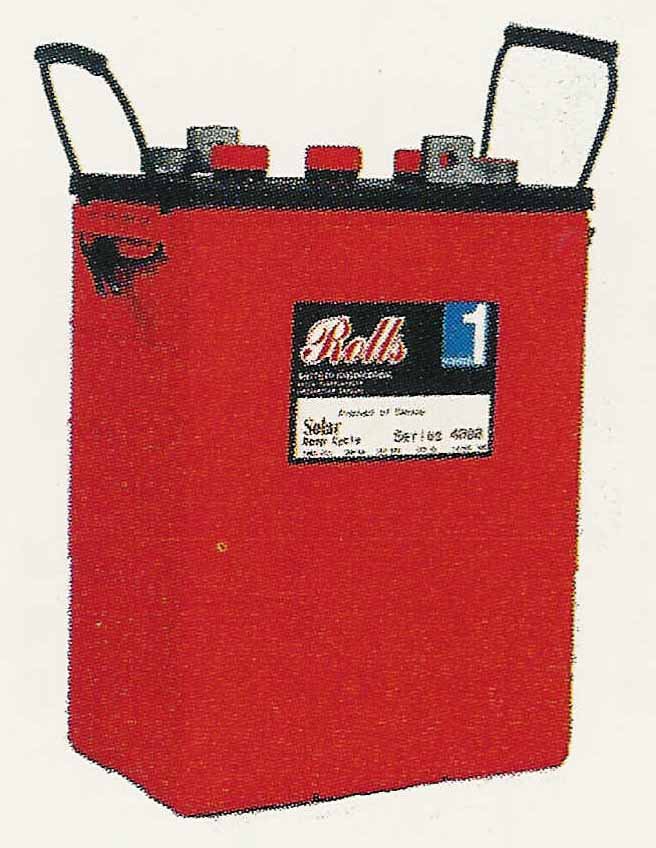
The ROLLS (Surrette) S-460
Comparable to the popular "L-16", these
batteries are unsurpassed in performance and warranty for small to
mid-sized systems. Here's the specs:
|
|
| Model 6V 3 Cell |
CAP. 100 hr.rate |
CAP.20 hr.rate |
Length |
Width |
Height |
Weight |
Price |
| S-460 |
460ah |
350ah |
12.3" |
7.1" |
16.8" |
117 lbs |
call |
| S-530 |
530ah |
400ah |
12.3" |
7.1" |
16.8" |
127 lbs |
call |
| There are more Surrette Rolls Series 4000 and 5000 Batteries
available, please call for further information. Surrette Rolls
are made in Canada. |
 |
These batteries feature the use of the
thickest plate, highest density active material in plate construction;
their service life averages ten years. They have an increased
liquid reserve--which makes for less maintenance. Rolls Battery
Engineering has been making batteries for more than 60 years.
These quality units are suitable for back-up power for residential
applications, as well as remote monitoring stations, navigation aids,
refrigeration and uninterrupted power systems.
The maximum number of these to safely
series/parallel is 16. If you need more batteries to meet
your storage needs, consider the 2V cells. Call us if you have
questions about this.
|
|
Seven year warranty, the first
two years full and the next 60 months prorated. Replacement batteries
do not ship freight free.
Other 6V and 12V batteries available; let us know your project
specifications! These may have as long as a 2 to 3 week lead time, but
usually less.
|
|
|
HEAVY DUTY
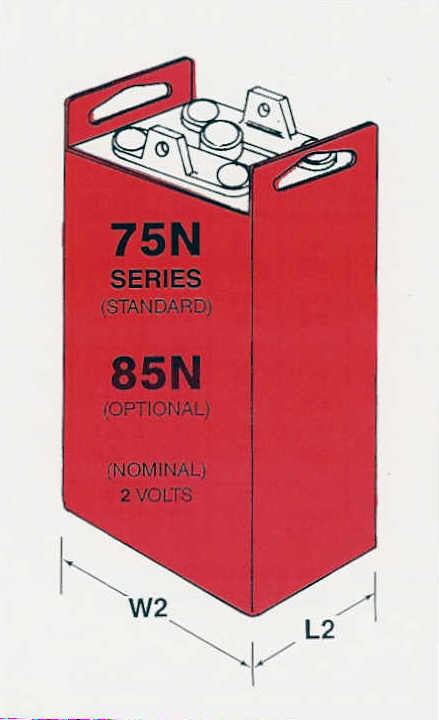
INDUSTRIAL 2V CELLS FROM INDUSTRIAL BATTERY ENGINEERING (IBE) |

Click to enlarge |
These are the crème de la
crème of long lasting batteries; despite their initial cost, because
of their longevity they are the best deal, dollar-per-amphour. They
offer a five year warranty, and generally last 18 to 20 years in a
back-up power system--and sometimes as long as 25 years, with proper
cycling and maintenance!
|
|
Standard features:
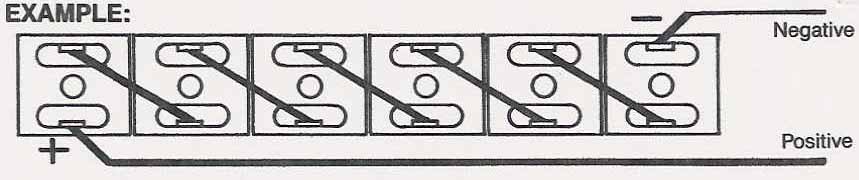
- Flag type terminals on positive and negative posts for
easy installation. One built-in heavy duty battery interconnect
included on all but the last battery, thusly:
|
|

|
- The cell is high
capacity industrial type for deep cycle applications and high recovery
characteristics.
- Heat seal cell cover to eliminate the major source of
electrolyte leakage and thereby reducing corrosion buildup.
- Sealing compound around the edge of the case and cell
to reduce the problem of electrolyte starting the corrosion process at
the edge of the steel case.
- Powder coat paint is standard; it is highly acid
resistant and tough.
- Lifting handles are provided for ease of handling and
transport (whew!--if you've ever moved these big guys, you know what a
boon this is!).
- Batteries can be discharged to 80% of rated capacity
with no plate damage. Heavy charging will return battery specific
gravity level to approximately 1.275 to 1.285 measured by hydrometer.
- Industrial Level Antimony is 6% by weight and is
accepted for industrial deep cycling and enhanced recovery.
Plate thickness is approximately 43% greater than low antimony plates.
- Battery capacity ratings are based upon an ambient
temperature of 77°F (25°C).
- Cycle life: 1500 cycles @ 80% depth of discharge cycles;
5000 cycles @ 20% depth of discharge cycles.
- The minimum or final cell voltage is 1.70 VPC.
Call for your freight on these top-end batteries! Units ship
from California, and generally have a 2-3 week lead time. |
|
| Battery Model Number |
Amp Hour Capacity @ 20 hr. rate |
Amp hour Capacity @ 100 hr. rate |
Price per 2Vcell |
| 85N-17 |
836 |
1020 |
Call |
| 85N-19 |
941 |
1148 |
Call |
| 85N-21 |
1046 |
1275 |
Call |
| 85N-23 |
1150 |
1403 |
Call |
| 85N-25 |
1255 |
1530 |
Call |
| 85N-27 |
1359 |
1658 |
Call |
| 85N-29 |
1464 |
1785 |
Call |
| 85N-31 |
1568 |
1913 |
Call |
| 85N-33 |
1673 |
2040 |
Call |
|
|
Other notes on these fabulous batteries: these are
heavy duty, deep cycle, high recovery, industrial type cells.
You'll need six of these for a 12V system, 12 for a 24V system, etc.
Special packaging is available for export shipment, add $200 per
pallet to list price plus shipping.
Batteries available "dry charged" (no electrolyte), add
17% to list price.
Fewer than 6 cells, plastic or steel case adds $45 charge per cell;
otherwise that's included for a 6 cell (or more) purchase .
|
|
|
********
Also be sure to check out our
Solar-One deep cycle batteries
here, or check out our line of
Concorde Sun Xtender® batteries here.
********
HOW TO SIZE YOUR BATTERY BANK:
there's a fairly simple formula for figuring how many of what kind of
batteries you need for your power requirements. Here's how it
goes: first, you need to know how many watt-hours per day you need for
your power system. That is simply square one! Then, you take
that figure time 1.3 - the fudge factor (as batteries and other
components aren't 100% efficient) to get your "adjusted watt
hours needed per day". Now that you know that, take your
adjusted watt-hours per day times the number of days of battery
storage you'd like (we usually use at least a minimum of 3 and as much
as 14); then take that number times 2 (for 50% depth of discharge--you
never want to take your batteries lower than that), then take THAT
number divided by your system voltage (probably 12, 24 or 48V)--and
that equals the number of amphours of storage you need. So let's
use a figure--say you need 5000 watt hours per day; times 1.3 = 6500
"adjusted" watt-hours; take 6500 times 4 (for four days of
storage) = 26000 X 2 (for 50% depth of discharge) = 52000; divided by
24 (system voltage) = 2166 amp hours of storage.
NOW, if you need 2166 amphours of storage in a 24V system, and you
plan to utilize the Surrette batteries (above), divide 2166 by 460
equals 4.7...well, you can't have 7/10th of a battery, so you'd round
it to five. And since it takes four 6V batteries to make a set
in a 24V system, you'd need 20 of the Surrette S-460 batteries to give
you 5000 watt-hours a day, for four days, to 50% depth of discharge.
END OF LESSON. Questions, call me at 406-777-4321 or 4309 |
|
|
WHAT TRUCK FREIGHT ENTAILS: The best rate for
truck freight shipping is to have you pick it up at the local freight
terminal or commercial drop point. A residential delivery is usually $40
to $45 more than a business delivery, and, a lift gate (which drops the
goods off at ground level), is another $80 to $100 in additional fees.
Inside delivery is an additional cost on top of that.
Know someone with a truck? Can you have a dolly or hand cart on hand? If
you can mobilize a couple of strong bodies, you might be able to save
$80 to $120 or so!
Call for your freight on any of our truck freight items.
|
|